

In the beginning
LASIK eye surgery has become one of the most popular vision correction procedures worldwide. Millions of people choose LASIK to reduce or eliminate their dependence on glasses and contact lenses. The procedure uses advanced laser technology to reshape the cornea, allowing light to focus correctly on the retina and improving visual clarity.
However, not everyone is an ideal candidate for LASIK surgery. A thorough eye examination is necessary to determine whether the procedure is safe and effective for a particular individual. Understanding who is the right candidate for LASIK eye surgery can help patients make informed decisions about vision correction and achieve the best possible outcomes.
If you are considering LASIK eye surgery in Delhi, it is important to understand the eligibility criteria, benefits, limitations, and factors that ophthalmologists evaluate before recommending treatment.
Establishing An Understanding Of LASIK Eye Surgery :
LASIK (Laser-Assisted In Situ Keratomileusis) is a refractive eye surgery designed to correct common vision problems such as nearsightedness (myopia), farsightedness (hyperopia), and astigmatism. During the procedure, a specialized laser reshapes the cornea to improve the way light enters the eye.
The surgery is performed on an outpatient basis and usually takes only a few minutes per eye. Most patients experience significant vision improvement within a short period after the procedure.
Just Why Candidate Selection Important ?
Although LASIK is highly successful, proper patient selection is essential for safety and long-term results. Factors such as corneal thickness, eye health, age, prescription stability, and medical history influence whether a patient is suitable for LASIK.
Choosing the right candidate helps minimize risks, improve outcomes, and ensure long-lasting vision correction.
Table of Contents
1. Understanding LASIK Eye Surgery
2. How LASIK Corrects Vision
3. Who Is the Right Candidate for LASIK?
4. Eye Conditions LASIK Can Treat
5. Eligibility Requirements for LASIK
6. Who May Not Be Suitable for LASIK?
7. Pre-LASIK Eye Evaluation
8. Benefits of LASIK Surgery
9. LASIK Procedure Overview
10. Recovery After LASIK Surgery
11. Long-Term Vision Outcomes
12. Frequently Asked Questions
How LASIK Corrects Vision
Vision problems occur when light does not focus properly on the retina. LASIK reshapes the cornea so that incoming light is focused accurately, resulting in clearer vision.
| Condition | How LASIK Helps |
|---|---|
| Myopia (Nearsightedness) | Improves distance vision. |
| Hyperopia (Farsightedness) | Improves near vision. |
| Astigmatism | Corrects irregular corneal shape. |
Who Is the Right Candidate for LASIK Eye Surgery?
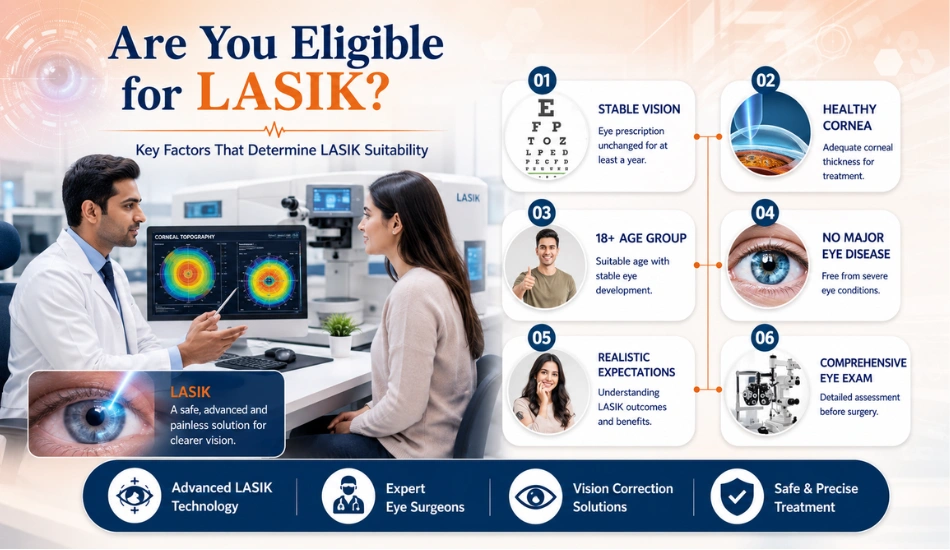
An ideal LASIK candidate generally meets several medical and vision-related requirements. Eye specialists carefully evaluate these factors before recommending surgery.
| Eligibility Factor | Ideal Requirement |
|---|---|
| Age | 18 years or older. |
| Stable Vision | Prescription stable for at least 1 year. |
| Healthy Cornea | Adequate corneal thickness and shape. |
| Good Eye Health | No active eye disease or infection. |
| Healthy Tear Production | No severe dry eye syndrome. |
| Realistic Expectations | Understanding benefits and limitations. |
| General Health | No uncontrolled medical conditions affecting healing. |
Eye Conditions LASIK Can Treat
LASIK is commonly recommended for:
- Mild to moderate myopia (nearsightedness).
- Hyperopia (farsightedness).
- Astigmatism.
- Dependence on glasses.
- Dependence on contact lenses.
- Vision correction for active lifestyles.
Patients involved in sports, travel, or professions requiring visual freedom often choose LASIK to improve convenience and quality of life.
Patient Preparation :
Before LASIK surgery, ophthalmologists perform a detailed eye evaluation that may include:
- Visual acuity testing.
- Refraction assessment.
- Corneal topography.
- Corneal thickness measurement.
- Tear film analysis.
- Pupil size measurement.
- Retinal examination.
These tests help determine whether LASIK is safe and suitable for the patient.
Who May Not Be Suitable for LASIK?
| Condition | Reason |
|---|---|
| Thin Corneas | May not support safe laser reshaping. |
| Severe Dry Eyes | Can worsen after surgery. |
| Keratoconus | Progressive corneal thinning disorder. |
| Pregnancy | Hormonal changes may affect vision stability. |
| Uncontrolled Diabetes | May interfere with healing. |
| Active Eye Infections | Surgery should be postponed until resolved. |
| Unstable Vision | Prescription changes may affect outcomes. |
Benefits of LASIK Eye Surgery
| Benefit | Advantage |
|---|---|
| Reduced Dependence on Glasses | Greater visual freedom. |
| Quick Procedure | Usually completed within minutes. |
| Rapid Recovery | Vision improves quickly. |
| Minimal Discomfort | Generally painless procedure. |
| Long-Term Results | Stable vision correction for many patients. |
| Improved Lifestyle | Enhanced convenience for sports and travel. |
The day of the magical operation :
During LASIK surgery:
- Anesthetic eye drops are applied.
- A thin corneal flap is created.
- The laser reshapes the cornea.
- The flap is repositioned naturally.
- No stitches are required.
- The patient returns home the same day.
The actual laser treatment usually takes only a few seconds per eye.
The Superhero Tools :
Modern LASIK centers utilize advanced technologies such as:
- Femto LASIK systems.
- Wavefront-guided LASIK.
- Contoura Vision technology.
- Computerized corneal mapping.
- High-precision excimer lasers.
These technologies improve accuracy, customization, and visual outcomes.
Recovery Time :
LASIK recovery is typically fast, with many patients noticing improved vision within 24 to 48 hours.
| Recovery Stage | Expected Progress |
|---|---|
| First 24 Hours | Mild irritation and blurry vision may occur. |
| 2–3 Days | Vision becomes significantly clearer. |
| 1 Week | Most normal activities can be resumed. |
| 1 Month | Vision continues to stabilize. |
| 3–6 Months | Optimal visual outcomes achieved. |
Taking Care of Yourself :
After LASIK surgery, patients should:
- Use prescribed eye drops regularly.
- Avoid rubbing the eyes.
- Wear protective sunglasses outdoors.
- Limit screen exposure initially.
- Avoid swimming temporarily.
- Attend all follow-up appointments.
Following post-operative instructions carefully helps ensure smooth healing and long-term success.
A Guide to Feeling Better :
The right candidate for LASIK eye surgery is someone with stable vision, healthy eyes, adequate corneal thickness, and realistic expectations about the procedure. A comprehensive eye examination by an experienced ophthalmologist is essential to determine eligibility and choose the most appropriate vision correction option. For suitable candidates, LASIK offers a safe, effective, and long-lasting solution to reduce dependence on glasses and contact lenses while improving overall quality of life.
FAQs
1. What is the ideal age for LASIK eye surgery?
Most eye specialists recommend LASIK for individuals aged 18 years or older with a stable vision prescription.
2. Can people with high eye power undergo LASIK?
Many patients with moderate to high refractive errors may qualify, but eligibility depends on detailed eye evaluation results.
3. Is LASIK safe?
Yes, LASIK is considered a safe and effective procedure when performed by experienced ophthalmologists on suitable candidates.
4. How long does LASIK surgery take?
The procedure usually takes about 10–15 minutes for both eyes, with the laser treatment lasting only seconds.
5. Can vision problems return after LASIK?
LASIK provides long-term vision correction for most patients, although age-related eye changes may still occur later in life.