
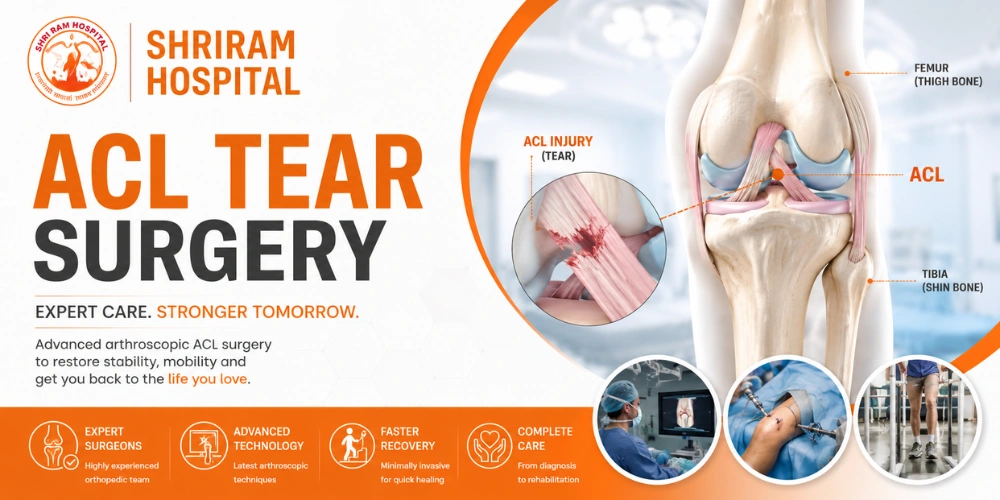
ACL Surgery at Shri Ram Hospital, Vikaspuri
A knee ligament injury can affect every part of daily life, from walking and climbing stairs to playing sports. Whether it happens during sport, a sudden twist or a road accident, early diagnosis and expert orthopaedic care help restore knee stability and prevent long-term joint damage.
Shri Ram Hospital's Orthopaedics Department offers advanced arthroscopic techniques to repair or reconstruct a torn ligament and restore knee stability and function. Our approach for athletes and active people focuses on minimal invasiveness, effective rehabilitation and a swift return to activity.
Our orthopaedic surgeons are experienced in the latest ACL repair and reconstruction methods, using autografts or allografts to achieve a strong, durable ligament. Pre-operative planning and imaging ensure each procedure is precisely executed, with attention to alignment and joint mechanics.
Located in Vikaspuri, West Delhi, we treat patients from Janakpuri, Uttam Nagar, Dwarka, Tilak Nagar, Paschim Vihar, Rajouri Garden, Punjabi Bagh, Kirti Nagar, Naraina, Peeragarhi, Nangloi and across Delhi NCR.
Why Choose Shri Ram Hospital for ACL Surgery?
Choosing the right orthopaedic hospital is one of the most important factors in successful ACL reconstruction. Every patient receives a plan based on the severity of the injury, activity level, occupation and sports goals.
Why Patients Trust Shri Ram Hospital
| Our Expertise | Patient Benefits |
|---|---|
| Experienced orthopaedic and sports injury surgeons | Specialists experienced in ACL reconstruction and advanced knee ligament surgery. |
| Arthroscopic ACL reconstruction | Minimally invasive procedures that reduce pain, limit tissue damage and support faster recovery. |
| Modern operation theatres | High-definition arthroscopy systems for precise ligament reconstruction. |
| MRI and digital diagnostics | Accurate imaging for proper surgical planning. |
| Personalised physiotherapy and rehabilitation | Structured programmes to restore strength, balance and knee function. |
| Comprehensive sports injury care | Diagnosis, surgery, rehabilitation and follow-up under one roof. |
| NABH and ISO accredited multispeciality hospital | Recognised standards of quality and patient safety. |
| Cashless treatment for eligible patients | Cashless care through approved insurance providers and government health schemes. |
| Convenient location | Easy access from West Delhi and across Delhi NCR. |
Our goal is to restore knee stability, improve mobility, shorten recovery time and help you return confidently to work, sport and everyday life.
What Is an ACL Injury?
The Anterior Cruciate Ligament (ACL) is one of the strongest and most important ligaments of the knee. It connects the thigh bone (femur) to the shin bone (tibia) and keeps the knee stable while walking, running, jumping and changing direction.
An ACL tear happens when the ligament is stretched beyond its limit or ruptures completely. It commonly occurs during sudden twisting, pivoting, awkward landings or a direct blow to the knee.
People at Higher Risk of ACL Injuries
- Football players: Frequent pivoting, sudden acceleration and tackling increase the risk.
- Cricket players: Sudden turns and fielding injuries may damage the ACL.
- Basketball players: Jumping and rapid changes of direction place heavy stress on the ligament.
- Badminton players: Fast sideways movement and quick pivots raise the chance of ligament injury.
- Gym enthusiasts: Incorrect lifting technique or high-impact exercise may contribute.
- Dancers: Repetitive twisting and landing strain the knee ligaments.
- Road accident victims: High-impact trauma may cause a partial or complete ACL tear.
Without proper treatment, an ACL tear can lead to chronic knee instability, repeated injuries, meniscus damage, cartilage wear and early osteoarthritis.
Common Symptoms of an ACL Tear
ACL injuries often cause immediate symptoms that should not be ignored. Early evaluation by an experienced orthopaedic doctor allows timely diagnosis and better long-term results.
Warning Signs of an ACL Injury
- A popping sound: Many patients hear or feel a distinct pop when the ligament tears.
- Sudden severe knee pain: Pain right after a twist or direct injury to the knee.
- Rapid swelling: Swelling often appears within hours because of bleeding inside the joint.
- Knee instability or giving way: The knee feels unstable or buckles while walking or turning.
- Difficulty walking: Pain, swelling and instability make normal walking hard.
- Limited knee movement: Reduced ability to bend or straighten the knee comfortably.
- Pain while climbing stairs: Stairs become painful because of ligament instability.
- Difficulty running or changing direction: Sports involving cutting or pivoting become unsafe.
A clinical examination and MRI help confirm the diagnosis and improve the chances of a full recovery.
ACL Injury Treatment
The right treatment depends on several factors. After a detailed orthopaedic evaluation, your surgeon recommends an individual plan based on the severity of the injury and your lifestyle needs.
Factors That Influence Treatment
- Severity of the tear: Partial and complete ACL tears need different approaches.
- Patient's age: Age and expected activity level guide the plan.
- Activity level: Athletes and very active people often need surgical reconstruction for stability.
- Occupation: Physically demanding jobs may call for earlier surgery.
- Sports participation: Patients who want to return to competitive sport usually benefit from reconstruction.
- Meniscus or cartilage injury: Associated injuries may be treated during the same surgery.
Non-Surgical ACL Treatment
Patients with partial ACL tears, lower activity levels or stable knees may do well without surgery.
- Physiotherapy: Structured rehabilitation strengthens the muscles around the knee and improves stability.
- Knee bracing: Functional braces give extra support during recovery and daily activity.
- Pain management: Medicines and other measures reduce pain and inflammation.
- Muscle strengthening: Stronger quadriceps and hamstrings improve knee stability.
- Activity modification: Avoiding high-impact sport and sudden twisting lowers the risk of further injury.
However, patients with a complete ACL tear and ongoing instability generally get the best long-term results from surgical reconstruction.
Arthroscopic ACL Reconstruction Surgery
Arthroscopic ACL reconstruction is considered the gold standard for complete ACL tears. The damaged ligament is replaced with a tendon graft through small incisions, using a camera (arthroscope) inside the knee.
This approach restores knee stability while limiting tissue damage and supporting faster rehabilitation.
Benefits of Arthroscopic ACL Reconstruction
- Small incisions: Less tissue damage and smaller scars.
- Minimal blood loss: Arthroscopic surgery reduces surgical bleeding.
- Less post-operative pain: Generally more comfortable than traditional open surgery.
- Faster recovery: Early rehabilitation helps regain knee function sooner.
- Lower infection risk: Smaller incisions help reduce the risk of infection.
- Early mobilisation: Physiotherapy begins soon after surgery to restore movement.
- Improved knee stability: Reconstruction restores normal ligament function and helps prevent repeated giving way.
- Return to sport and daily life: A structured programme supports a safe return to activity.
Types of ACL Reconstruction Grafts
Choosing the right graft is an important part of ACL reconstruction. The choice depends on your age, activity level, sports and your surgeon's assessment.
Hamstring Tendon Graft
- Commonly used: One of the preferred graft options for ACL reconstruction.
- Good strength: Provides reliable long-term knee stability.
- Smaller incision: Needs a relatively small incision for graft harvesting.
Patellar Tendon Graft
Often chosen for competitive athletes, high-performance sport and patients who need maximum knee stability, as it offers excellent fixation and long-term performance.
Quadriceps Tendon Graft
Suitable for selected patients who need a strong graft while keeping donor-site discomfort low and knee function high.
Allograft (Donor Tissue)
May be considered in selected situations, particularly revision ACL surgery or when an autograft is not the preferred option.
Ligament Tear Operation: What to Expect
Knowing each stage of treatment helps you feel prepared. Every ACL reconstruction at Shri Ram Hospital is planned carefully and followed by a structured rehabilitation programme.
Step 1: Diagnosis
A detailed evaluation confirms the ACL injury and checks for damage to the meniscus, cartilage or other ligaments.
- Physical examination: The surgeon checks stability, swelling, pain, movement and ligament integrity.
- MRI scan: Detailed images of the ACL, meniscus, cartilage and soft tissue show the severity of the injury.
- X-rays: Digital X-rays rule out fractures or alignment problems.
- Knee stability tests: Clinical tests show the extent of ligament damage and whether surgery is needed.
Step 2: Pre-operative Planning
Your surgeon prepares an individual plan based on your knee condition, activity level and goals.
- Tear severity: Guides the technique and graft choice.
- Meniscus injuries: Associated tears are identified and repaired in the same procedure when appropriate.
- Cartilage damage: Assessed carefully because it affects long-term knee function.
- Knee alignment: Checked to optimise surgical results.
- Activity level: Age, job and sport guide graft selection and rehabilitation.
Step 3: Arthroscopic Surgery
ACL reconstruction is performed with a high-definition arthroscope inserted through small incisions. The damaged ACL is removed and replaced with a tendon graft that restores stability and normal joint mechanics.
This minimally invasive technique limits tissue damage, reduces post-operative pain and lowers infection risk compared with open surgery.
Step 4: Rehabilitation
Rehabilitation is one of the most important parts of recovery. Physiotherapy starts soon after surgery and progresses step by step.
- Strength: Progressive exercises rebuild muscle support around the knee.
- Flexibility: Gentle stretching restores normal movement.
- Balance: Balance training improves joint control and lowers the risk of another injury.
- Joint stability: Functional rehabilitation restores confidence while walking, running and playing.
- Functional movement: Sport-specific exercises prepare you for work and sport.
Recovery After ACL Surgery
Recovery combines healing with a structured rehabilitation programme. Success depends on regular physiotherapy and following your surgeon's instructions.
Every timeline is different and depends on the injury, graft type, any meniscus repair and your general health.
First Week After Surgery
The focus is on reducing pain and swelling and starting gentle movement under supervision.
- Pain management: Prescribed medicines control discomfort and help early movement.
- Ice therapy: Cold therapy reduces swelling and inflammation.
- Swelling reduction: Elevating the leg and following physiotherapy advice speeds recovery.
- Assisted walking: Most patients walk with crutches or a walker as advised.
- Gentle exercises: Early exercises maintain joint movement and prevent stiffness.
Recovery During Weeks 2 to 6
Physiotherapy becomes more intensive to improve strength, flexibility and knee control.
- Better knee movement: Range-of-motion exercises restore normal flexibility.
- Muscle strengthening: Quadriceps, hamstrings and surrounding muscles are strengthened.
- Balance training: Exercises improve stability and lower the risk of re-injury.
- Supervised sessions: Guided rehabilitation ensures safe progress.
Recovery During Months 2 to 6
Advanced rehabilitation restores functional movement and prepares you for higher activity.
- Cycling: Low-impact cycling improves mobility and endurance.
- Functional exercises: Activity-specific exercises improve coordination and stability.
- Light jogging: Started only after medical clearance, once healing and strength allow.
- Advanced rehabilitation: Sport-specific exercises prepare athletes for safe return.
Return to Sports
Return to sport depends on functional recovery, not time alone. Before competing again you are assessed for strength, balance, agility and knee stability.
Most athletes return to competitive sport about 9 to 12 months after ACL reconstruction, depending on healing, rehabilitation progress and your surgeon's clearance.
ACL Surgery Cost in Delhi
A common question is: what is the ACL surgery cost in Delhi? The total cost differs from patient to patient because every ligament injury needs an individual plan.
At Shri Ram Hospital, every patient has an orthopaedic consultation, examination and MRI evaluation first. Based on the tear, associated injuries, graft choice and rehabilitation needs, our surgeons give a clear treatment plan with a personalised cost estimate.
Factors Affecting ACL Surgery Cost
| Factor | How It Affects the Cost |
|---|---|
| Type of graft used | Hamstring, patellar tendon, quadriceps tendon or allograft reconstruction involve different planning and techniques. |
| Implant quality | The type of fixation implants used influences the treatment package. |
| Complexity of the injury | Partial tears, complete ruptures, revision surgery or multiple ligament injuries need different levels of expertise. |
| Associated meniscus repair | A torn meniscus may be repaired during the same procedure. |
| Hospital stay | Depends on your recovery and general medical condition. |
| Rehabilitation programme | Physiotherapy plays an important part in recovery. |
| Insurance or cashless cover | Eligible insurers and government-approved schemes may reduce your expenses. |
Why Early ACL Treatment Matters
Delaying treatment can increase the risk of progressive knee damage. An unstable knee is more likely to be injured again during routine activity and sport, which can lead to permanent joint damage.
Early diagnosis and timely ACL reconstruction help restore stability, protect the meniscus and cartilage and reduce the risk of future problems.
Complications of Delaying ACL Treatment
- Meniscus tears: Instability raises the risk of damage to the meniscus, the knee's natural shock absorber.
- Cartilage damage: Repeated instability gradually wears down the cartilage covering the joint.
- Recurrent instability: The knee may give way repeatedly while walking, running or turning.
- Early osteoarthritis: Untreated injuries may speed up joint degeneration.
- Reduced sports performance: Instability limits running, jumping and pivoting.
- Long-term knee pain: Chronic instability can cause lasting pain and reduced mobility.
Early orthopaedic consultation and timely reconstruction improve long-term knee function and quality of life.
This page gives general information and is not a substitute for medical advice. Treatment depends on a doctor's examination. In an emergency call +91 62623 04050.