
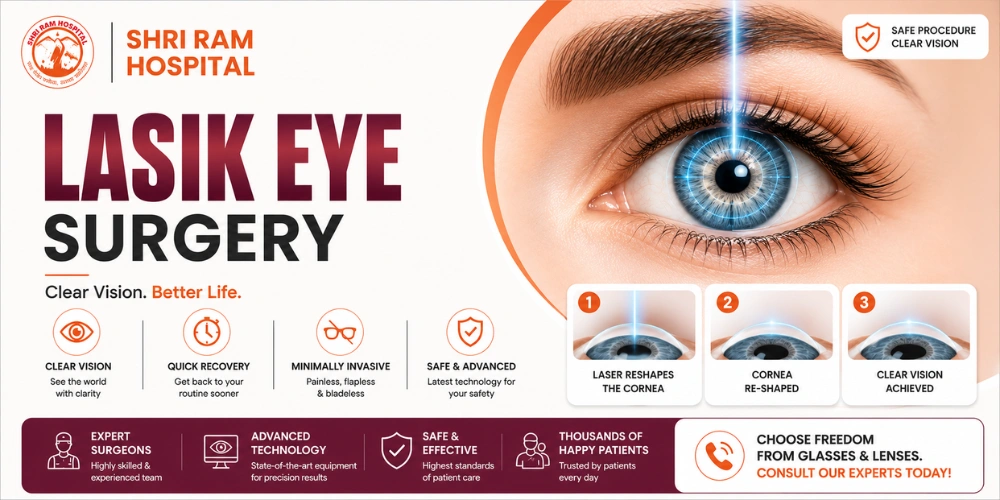
LASIK Eye Surgery at Shri Ram Hospital, Vikaspuri
LASIK eye surgery is one of the most popular and effective vision correction procedures available today. Millions of people worldwide have chosen LASIK to reduce or remove their dependence on glasses and contact lenses. If you are considering LASIK in Delhi, understanding the procedure, benefits, eligibility and the factors that affect cost helps you make an informed decision.
At Shri Ram Hospital, we offer advanced vision correction by experienced eye specialists using modern laser technology. Whether you are researching LASIK surgery cost in Delhi or laser eye surgery cost in Delhi, or looking for the best LASIK eye surgery in Delhi, our team is committed to personalised eye care and excellent visual outcomes.
What Is LASIK Eye Surgery?
LASIK (Laser-Assisted In Situ Keratomileusis) is an advanced laser vision correction procedure that reduces or removes the need for spectacles and contact lenses. It corrects common refractive errors by reshaping the cornea so that light entering the eye focuses accurately on the retina and produces clear vision.
LASIK is widely performed across the world because it is a safe, effective, minimally invasive procedure with a quick recovery. Most patients notice a clear improvement in vision within a short time and resume normal daily activities quickly.
Conditions Corrected by LASIK Eye Surgery
- Nearsightedness (myopia): You see nearby objects clearly but distant objects are blurred because light focuses in front of the retina.
- Farsightedness (hyperopia): Near objects are hard to focus on and, in some cases, distance vision is affected because light focuses behind the retina.
- Astigmatism: An irregularly shaped cornea causes blurred or distorted vision at all distances.
By reshaping the cornea with advanced laser technology, LASIK helps improve visual clarity and significantly reduces dependence on glasses or contact lenses.
Who Can Benefit from LASIK Surgery?
LASIK is not suitable for everyone. Before recommending treatment, your ophthalmologist does a comprehensive eye examination to check your vision, corneal thickness, eye health and refractive error. This assessment shows whether LASIK is the safest and most effective option for you.
Who Is a Suitable Candidate for LASIK?
- Above 18 years of age: LASIK is generally recommended for adults whose vision has matured and remained stable.
- Stable spectacle number: Your prescription should stay unchanged for at least one year before surgery.
- Healthy corneas: Adequate corneal thickness and a healthy corneal structure are essential for safe laser correction.
- No active eye infection: LASIK is done only when there is no ongoing infection, inflammation or other temporary eye condition.
- Free from certain eye diseases: Advanced glaucoma, severe dry eye, progressive keratoconus or retinal disorders may affect eligibility.
- Wish to reduce dependence on glasses or lenses: LASIK suits people who want greater visual freedom in daily life, sport or work.
A detailed pre-LASIK eye examination is essential to confirm suitability and recommend the most appropriate procedure for your eyes.
Conditions Treated by LASIK
LASIK is mainly performed to correct refractive errors that affect how light focuses on the retina. Correcting these problems gives clearer vision and improves quality of life.
Common Vision Problems Corrected by LASIK
| Condition | Description |
|---|---|
| Myopia (nearsightedness) | Nearby objects are clear but distance vision is blurred because light focuses in front of the retina. |
| Hyperopia (farsightedness) | Mainly affects near vision and, in some cases, distance vision as well, due to improper focusing of light. |
| Astigmatism | An irregularly shaped cornea causes blurred or distorted vision at both near and far distances. |
LASIK reshapes the cornea to correct these errors, giving sharper vision and reducing the need for spectacles or contact lenses for many patients.
Types of LASIK Eye Surgery
Modern vision correction offers several advanced procedures. The most suitable option depends on your eye health, corneal thickness, refractive error, lifestyle and visual expectations. Your ophthalmologist recommends the best treatment after a comprehensive pre-LASIK evaluation.
Conventional LASIK
A thin corneal flap is created and the cornea is then reshaped with an excimer laser. It has been used successfully for many years to correct refractive errors with excellent visual outcomes.
Bladeless LASIK Surgery
This advanced procedure uses a femtosecond laser instead of a mechanical blade to create the corneal flap, giving greater precision and better patient comfort.
- Greater precision: Laser technology creates an extremely accurate corneal flap.
- Enhanced safety: The bladeless technique reduces the use of mechanical instruments.
- Faster healing: Many patients recover sooner and see better earlier.
- Improved patient comfort: A smoother surgical experience with minimal discomfort.
Because of these advantages, many patients look up the bladeless LASIK surgery cost while exploring advanced vision correction options.
Contoura Vision LASIK
This highly advanced procedure uses detailed corneal mapping to create a customised treatment plan. In suitable patients it helps improve visual quality while reducing glare and improving contrast sensitivity.
SMILE Vision Correction
SMILE (Small Incision Lenticule Extraction) is a minimally invasive laser vision correction procedure that needs only a tiny incision. It suits selected patients depending on their refractive error and corneal characteristics.
After a comprehensive eye examination, your ophthalmologist recommends the most appropriate LASIK or laser vision correction procedure for your eye condition, lifestyle and long-term visual goals.
LASIK Surgery Cost in Delhi
One of the most common questions before vision correction is about the LASIK surgery cost in Delhi. The cost varies from patient to patient because every eye has unique clinical needs and may need a different approach.
The final cost depends on the type of LASIK procedure, the technology used, the complexity of the refractive error and the treatment plan recommended after a detailed eye examination. After evaluating your eyes, your ophthalmologist prepares a personalised plan with a transparent estimate.
Factors Affecting LASIK Surgery Cost in Delhi
| Factor | How It Influences the Cost |
|---|---|
| Type of LASIK procedure | Conventional LASIK, Bladeless LASIK, Contoura Vision and SMILE differ in technology and technique, so costs differ. |
| Technology used | Advanced laser platforms and customised vision correction technology may influence the overall cost. |
| Degree of refractive error | The severity of myopia, hyperopia or astigmatism may affect treatment planning. |
| Corneal thickness | Corneal measurements decide eligibility and help the surgeon choose the safest procedure. |
| Diagnostic evaluation | Detailed pre-LASIK investigations assess eye health and customise the treatment plan. |
| Surgeon expertise | The experience and skill of the ophthalmologist contribute greatly to quality and outcomes. |
| Hospital infrastructure | Modern laser equipment, operation theatres and eye care facilities influence the package. |
| Follow-up care | Post-operative consultations and medicines are part of successful vision correction. |
Remember that the best LASIK treatment is not decided by cost alone. Safety, technology, surgeon expertise and long-term visual outcome matter equally.
What May Be Included in the LASIK Treatment Package?
The LASIK eye surgery cost in Delhi differs for every patient. A detailed pre-operative assessment is essential before the most suitable option is recommended.
| Included Service | Description |
|---|---|
| Comprehensive eye examination | A detailed assessment of overall eye health and refractive error before surgery. |
| Corneal topography | Advanced corneal mapping to evaluate corneal shape and treatment suitability. |
| Vision testing | A complete visual assessment to find the exact refractive correction needed. |
| LASIK procedure | Laser vision correction using the technique recommended by your ophthalmologist. |
| Medicines | Prescription eye drops and medicines to support healing and reduce infection risk. |
| Follow-up consultations | Scheduled post-operative visits to monitor healing and visual outcome. |
Laser Eye Surgery Cost in Delhi: What Affects It?
Many patients search for the laser eye surgery cost in Delhi while comparing vision correction procedures. The cost depends on the technology used, the complexity of the refractive error and the customised plan prepared after your eye examination.
| Factor | Impact on Treatment Cost |
|---|---|
| Type of laser technology | Advanced laser platforms give greater precision and may influence the overall cost. |
| Conventional or bladeless LASIK | The chosen technique plays an important role in the final package. |
| Customised treatment planning | Personalised correction using advanced corneal mapping may affect pricing. |
| Complexity of refractive error | Higher degrees of myopia, hyperopia or astigmatism may need more customised planning. |
| Additional diagnostic investigations | Complete pre-operative investigations help ensure safe treatment and good outcomes. |
Eye Operation Cost in Delhi
The eye operation cost in Delhi varies widely because different eye conditions need different procedures, technologies and approaches. LASIK is only one of several advanced eye surgeries performed by ophthalmologists.
- Surgical procedure: The type of eye surgery has a major impact on the overall cost.
- Equipment and technology: Advanced laser systems and modern ophthalmic equipment support safer surgery and better outcomes.
- Complexity of the case: More complex eye conditions may need specialised treatment and extra care.
- Experience of the surgeon: Skilled ophthalmologists help ensure greater safety and better long-term results.
- Hospital facilities: Modern operation theatres and diagnostic facilities influence the package.
- Post-operative care: Follow-up consultations, medicines and recovery support are part of successful eye surgery.
LASIK Price: What Determines the Cost?
Many patients compare the LASIK price before deciding. However, the cost depends on several medical and technological factors rather than one fixed figure.
- Standard LASIK vs bladeless LASIK: Advanced bladeless procedures generally involve different technology and planning.
- Customised vision correction: Personalised corneal mapping and customised laser treatment may influence pricing.
- Diagnostic testing: Detailed eye investigations are essential for eligibility and planning.
- Surgeon experience: The ophthalmologist's expertise plays an important role in safety and visual outcome.
- Hospital quality standards: Accredited hospitals with advanced infrastructure provide complete care through the treatment.
- Follow-up care: Regular post-operative visits help monitor healing and optimise long-term results.
Choose a LASIK procedure that gives long-term visual quality, safety and satisfaction rather than selecting only on price.
Laser Operation for Eyes Cost: Long-Term Benefits
When evaluating the laser operation for eyes cost, also consider the long-term benefits. Although LASIK is an initial investment, many patients enjoy lasting visual improvement and less need for corrective eyewear.
- Reduced dependence on spectacles: Many patients no longer need glasses for routine daily activities.
- Freedom from contact lenses: LASIK reduces or removes the need for lenses and their ongoing upkeep.
- Improved daily convenience: Everyday tasks become easier without constant reliance on eyewear.
- Better sport and outdoor activity: Clear vision without glasses or lenses adds comfort during physical activity.
- Enhanced quality of life: Many patients report more confidence and satisfaction with their vision.
Over the long term, many people find that LASIK becomes cost-effective compared with the recurring expense of spectacles, lenses, solutions and frequent prescription changes.
Why Choose LASIK Surgery in Delhi?
Delhi is a preferred destination for LASIK eye surgery because of its experienced ophthalmologists, advanced laser technology and modern eye care facilities. Patients from across India visit for safe, effective and customised vision correction.
Choosing the right eye hospital is essential for the best visual outcome. A comprehensive eye evaluation, advanced diagnostic equipment, experienced surgeons and personalised planning all contribute to successful LASIK.
Advantages of Choosing LASIK Surgery in Delhi
| Advantage | Patient Benefit |
|---|---|
| Experienced ophthalmologists | Highly qualified eye specialists with extensive experience in advanced laser vision correction. |
| Modern laser technology | Advanced laser platforms give precise correction with excellent safety and predictable outcomes. |
| Advanced diagnostic facilities | Comprehensive eye investigations determine LASIK eligibility and support personalised planning. |
| High standards of patient care | Dedicated eye care teams ensure comfort, patient education and continuous support. |
| Customised treatment options | Conventional LASIK, Bladeless LASIK, Contoura Vision and SMILE based on your eye condition. |
Why Choose Shri Ram Hospital for LASIK Eye Surgery?
Patients searching for the best LASIK eye surgery in Delhi choose Shri Ram Hospital for safe, advanced and patient-focused eye care. Our ophthalmologists combine modern laser technology with evidence-based protocols to achieve excellent visual outcomes.
From the first consultation to post-operative follow-up, every patient receives personal attention, detailed counselling and a plan designed around their visual needs.
Why Patients Trust Shri Ram Hospital
| Our Expertise | Patient Benefits |
|---|---|
| Experienced eye specialists | Skilled ophthalmologists with extensive experience in LASIK and advanced laser vision correction. |
| Advanced LASIK technology | Modern laser platforms for precise, safe and customised vision correction. |
| Comprehensive pre-LASIK evaluation | Detailed eye examination, corneal mapping and vision assessment to find the safest option. |
| Personalised treatment planning | Recommendations based on refractive error, corneal health, lifestyle and expectations. |
| Modern operation theatre facilities | Advanced infrastructure with state-of-the-art laser technology for patient safety. |
| Patient-focused care | Compassionate support and transparent communication throughout the treatment. |
| Evidence-based protocols | Procedures follow current clinical guidelines and accepted safety standards. |
| Comprehensive follow-up | Regular post-operative visits to monitor healing and long-term visual stability. |
Our mission is to help every patient achieve clearer vision through advanced laser eye surgery, personalised treatment and long-term eye care to the highest standards of safety and quality.
Recovery After LASIK Surgery
Recovery after LASIK is generally quick, and most patients resume their normal routine within a short period. Many notice a significant improvement in vision within the first 24 to 48 hours.
Vision improves rapidly, but complete stabilisation may take several weeks. Following your ophthalmologist's instructions carefully gives the best visual outcome and lowers the risk of complications.
What to Expect After LASIK Surgery
| Recovery Milestone | Expected Outcome |
|---|---|
| Improved vision | Most patients notice clearer vision within 24-48 hours after the procedure. |
| Minimal discomfort | Mild irritation, watering or light sensitivity usually improves within a few days. |
| Quick return to daily activities | Most people resume routine work shortly after surgery, as advised by their doctor. |
| Reduced dependence on glasses | Many patients enjoy significant freedom from spectacles and lenses after successful treatment. |
Post-Operative Care Instructions
- Use prescribed eye drops: Regular use prevents infection, reduces inflammation and promotes healing.
- Avoid rubbing the eyes: Rubbing during recovery may interfere with healing.
- Wear protective eyewear: Protective glasses shield the eyes from dust, accidental injury and bright sunlight.
- Attend follow-up appointments: Scheduled examinations let your ophthalmologist monitor healing and visual recovery.
Following all post-operative instructions greatly improves healing and long-term visual outcome.
Benefits of LASIK Eye Surgery
LASIK is one of the most popular vision correction procedures because it offers long-lasting visual improvement, minimal discomfort and a rapid recovery. For many patients it brings greater convenience and a better quality of life.
Advantages of LASIK Eye Surgery
- Quick procedure: LASIK usually takes only a few minutes per eye and is a convenient outpatient procedure.
- Minimal pain: Most patients feel little or no pain because anaesthetic eye drops are used.
- Fast recovery: Vision often improves within one to two days, so you return to normal activity quickly.
- Improved visual clarity: LASIK corrects refractive errors for sharper, clearer vision.
- Reduced dependence on glasses: Many people no longer need spectacles or lenses for most daily activities.
- Long-lasting results: For eligible patients with stable vision, LASIK gives durable correction for many years.
- High patient satisfaction: Millions of people worldwide report improved confidence, convenience and quality of life.
This page gives general information and is not a substitute for medical advice. Treatment depends on a doctor's examination. In an emergency call +91 62623 04050.