Digital X-Ray at Shri Ram Hospital, Vikaspuri
An X-ray is often the first test a doctor orders when you have an injury, bone or joint pain, a persistent cough or breathing trouble. It is quick and painless, and it shows what is happening inside the body so that treatment can start on the right track.
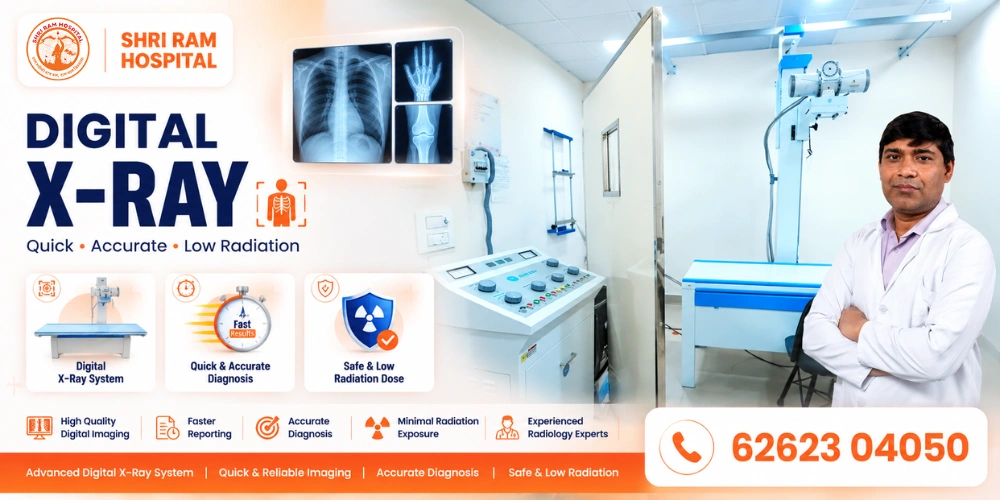
The Radiology Department at Shri Ram Hospital offers digital X-ray services. Because the hospital also has emergency care, orthopaedics, surgery and an ICU, imaging results reach the treating doctor quickly and care can move forward without delay.
We are in Vikaspuri, West Delhi, and serve patients from Janakpuri, Uttam Nagar, Dwarka, Tilak Nagar, Paschim Vihar, Rajouri Garden and across Delhi NCR.
What Is a Digital X-Ray?
A digital X-ray is a medical imaging test that uses a small, controlled amount of radiation to create pictures of the inside of the body, such as bones, the chest and the spine. Instead of photographic film, it uses an electronic detector, so the image appears on a computer screen within moments.
Digital X-Ray Compared With Film X-Ray
| Feature | How Digital X-Ray Helps |
|---|---|
| Image availability | The image appears on screen almost immediately, so there is no film to develop. |
| Image quality | Brightness and contrast can be adjusted on screen so the doctor can see details more clearly. |
| Repeat exposures | Because images can be checked at once and adjusted, fewer repeat X-rays are usually needed. |
| Storage and sharing | Images are stored electronically and can be shared with your treating doctor when needed. |
An X-ray is very useful, but it does not show everything. If your doctor needs more detail, other tests such as ultrasound, CT or MRI may be advised.
Types of X-Ray Tests
The type of X-ray depends on the part of the body your doctor wants to examine.
Common X-Ray Examinations
| X-Ray Test | What It Helps Evaluate |
|---|---|
| Chest X-ray | The lungs, heart size and airways. Used for cough, breathlessness, chest pain and infections such as pneumonia. |
| Bone and joint X-ray | Fractures, cracks, bone injuries, arthritis and joint problems in the arms, legs, hips, knees and other joints. |
| Spine X-ray | Spinal injuries, curvature such as scoliosis and age-related changes in the neck or back. |
| Dental X-ray | Cavities, gum and bone problems and the position of teeth. |
Your doctor will tell you which X-ray you need and why. Please do not ask for an X-ray without medical advice, since it is only done when it will help diagnosis.
Why Is an X-Ray Done?
Doctors ask for an X-ray to find or rule out a problem, to check how a condition is progressing, or to see how well treatment is working.
Common Reasons for an X-Ray
- Bone injuries: To detect fractures, cracks and other bone-related injuries after a fall, accident or sports injury.
- Joint conditions: To help diagnose arthritis and other joint abnormalities.
- Lung and chest problems: To look for infections such as pneumonia and other breathing-related conditions.
- Spine problems: To check for spinal injury and age-related changes.
- Dental problems: To find cavities and gum or bone disease that cannot be seen by looking in the mouth.
- Unusual growths or structural changes: To spot a lump or abnormal area that may need further tests.
- Follow-up after treatment: To check healing after a fracture or response to treatment.
In emergencies, an X-ray helps doctors reach a quick diagnosis and decide the next step.
When Do You Need an X-Ray?
See a doctor if you have any of the following. The doctor will decide whether an X-ray is needed.
Symptoms That May Need an X-Ray
- Bone pain that does not settle: Persistent pain may point to a fracture or another bone problem.
- Injury after a fall, accident or sports: Pain, swelling, bruising or inability to move or put weight on a limb.
- Joint pain or stiffness: Especially if it is getting worse or limiting daily activities.
- Cough, chest pain or breathing difficulty: A chest X-ray can help find the cause.
- Back or neck pain: Particularly after an injury or if it keeps coming back.
- Tooth pain or swelling: Dental X-rays can show problems below the gum line.
Chest pain with sweating or breathlessness, a severe injury or heavy bleeding is an emergency. Call +91 62623 04050 or come to our 24-hour emergency department.
Is Digital X-Ray Safe?
An X-ray uses a small amount of radiation. When it is done for a medical reason by trained staff, the benefit of finding the problem is greater than the small risk.
Safety Points to Know
- Only when medically needed: Doctors advise an X-ray when it will help diagnosis or treatment.
- Radiation kept as low as reasonably possible: The technician uses the settings that give a useful image with the least exposure and protects the areas not being imaged.
- Tell us if you are pregnant or may be pregnant: Always inform the doctor and the technician before the test so they can decide the safest option.
- Children: X-rays can be done in children when needed. Tell the staff your child age so the right settings are used.
- Painless and non-invasive: You do not feel the X-ray, and nothing is put inside your body.
What to Expect During Your X-Ray
Most X-rays need very little preparation and take only a few minutes.
Your Visit Step by Step
- Before the test: Carry your doctor prescription or request and any earlier X-rays or reports. Most tests need no special preparation unless your doctor tells you otherwise.
- Changing and removing items: You may be asked to remove jewellery, metal items or to wear a gown, depending on the area being imaged.
- Positioning: The technician places you in the right position. You may be asked to hold still or hold your breath for a moment.
- The X-ray: The picture is taken in seconds, and the image appears on the computer screen.
- After the test: You can usually return to normal activities. Your doctor will review the images and explain the findings and next steps.
Bringing earlier X-rays helps the doctor compare and see any change.
Why Choose Shri Ram Hospital for Digital X-Ray?
Good imaging helps your doctor decide correctly. Here is what you can expect from us.
Why Patients Trust Us
| Our Strength | Patient Benefit |
|---|---|
| Digital imaging equipment | Clear images that appear quickly for the doctor to review. |
| Trained technicians | Safe positioning, correct settings and care for patients of all ages. |
| Quick turnaround | Images are available immediately, helping treatment decisions without long waits. |
| Support for emergency and ICU care | Imaging works closely with the emergency department, orthopaedics and surgery teams. |
| Convenient location | Easily reached from Vikaspuri, Janakpuri, Uttam Nagar and the rest of West Delhi. |
| Diagnosis and treatment in one hospital | After the X-ray, you can see the right specialist in the same hospital. |
| NABH and ISO accredited hospital | Recognised standards of quality and patient safety. |
| Cashless for eligible patients | Cashless treatment through approved insurance providers and government health schemes. |
Our aim is reliable imaging that helps your doctor reach the right diagnosis and plan the right treatment.
This page gives general information and is not a substitute for medical advice. Treatment depends on a doctor's examination. In an emergency call +91 62623 04050.