Critical Care at Shri Ram Hospital, Vikaspuri
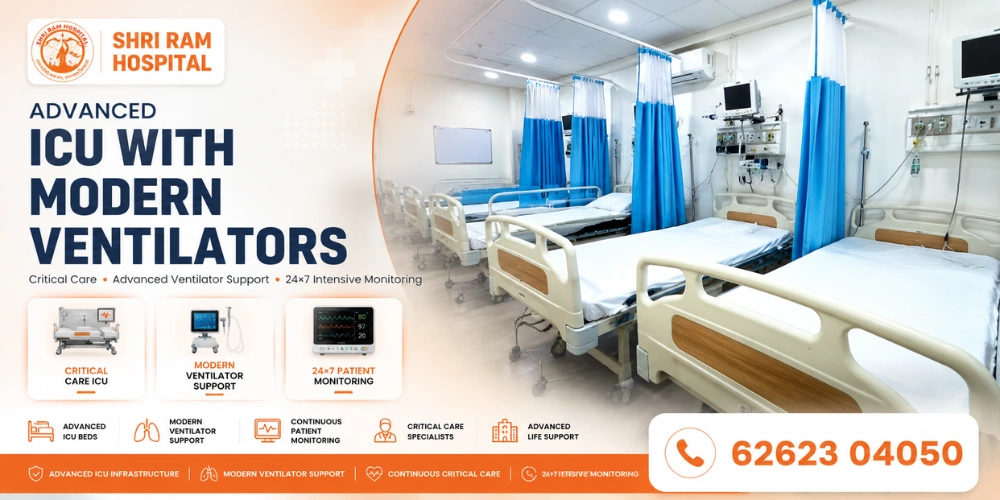
The Intensive Care Unit (ICU) at Shri Ram Hospital is built for patients who need close, continuous medical attention. It is equipped with modern ventilators, advanced monitoring and life-support technology, and staffed by a team trained in critical care.
Our ICU works around the clock to support patients with serious illness, severe infection, heart and breathing emergencies, brain and nerve problems, major injuries and complications after surgery. The focus is on quick action, constant monitoring and evidence-based treatment.
We are in Vikaspuri, West Delhi, and serve patients from Janakpuri, Uttam Nagar, Dwarka, Tilak Nagar, Paschim Vihar, Rajouri Garden, Punjabi Bagh and across Delhi NCR.
What Is an ICU and Who Needs It?
An Intensive Care Unit is a specialised hospital area that gives continuous monitoring and advanced treatment to critically ill patients. It has a higher nurse-to-patient ratio than a general ward and access to life-support equipment.
Doctors recommend ICU care when a patient's organs need support, or when their condition could worsen quickly and needs constant observation.
Conditions Commonly Managed in an ICU
- Respiratory failure: Severe breathing difficulty, pneumonia or lung infection that needs oxygen or ventilator support.
- Cardiac emergencies: Heart attack, serious rhythm problems and heart failure that need close monitoring.
- Neurological emergencies: Stroke, seizures and brain injury that need careful observation and support.
- Trauma and accidents: Major injuries that need intensive monitoring and coordinated specialist care.
- Severe infection and sepsis: Life-threatening infections that can affect blood pressure and organ function.
- After major surgery: Observation, pain control and breathing support while the patient recovers.
The decision to admit a patient to the ICU is always made by the treating doctors based on the patient's condition.
Ventilator Support
A ventilator is a machine that helps a person breathe when they cannot breathe well enough on their own. Air is delivered through a breathing tube or a tight-fitting mask, and the doctors adjust the settings to match the patient's needs.
Needing a ventilator does not mean there is no hope. For many patients it is a temporary support while the body heals, and the aim is always to take the patient off the ventilator as soon as it is safe.
When Ventilator Support May Be Needed
- Severe respiratory failure: The lungs cannot supply enough oxygen or remove carbon dioxide.
- Serious lung infection: Pneumonia or other infections that severely affect breathing.
- After major surgery or anaesthesia: Short-term breathing support while the patient recovers.
- Trauma or brain injury: When injury affects the ability to breathe or protect the airway.
- Other critical illness: Conditions in which the patient can no longer maintain adequate breathing alone.
Ventilator settings are watched closely and adjusted as the patient's condition changes. A patient may be given medicines to stay comfortable while on the ventilator.
24x7 Critical Care Monitoring
In the ICU, a patient's condition is checked continuously so that any change is noticed and treated quickly.
What Is Monitored
- Heart rate and rhythm: Continuous cardiac monitoring to detect rhythm problems.
- Blood pressure: Regular or continuous blood pressure checks.
- Oxygen levels: Oxygen saturation monitored to guide breathing support.
- Breathing rate and ventilator settings: Tracked so that support can be adjusted at once.
- Fluids, urine output and blood tests: Help doctors assess kidney function, hydration and infection.
Modern ICU Technology and Infrastructure
Good critical care depends on reliable equipment and a safe environment.
Our ICU Equipment and Safety Measures
| Feature | Purpose |
|---|---|
| Modern ventilators | Provide breathing support for patients with severe respiratory problems or critical illness. |
| Multiparameter patient monitors | Track heart rate, blood pressure, oxygen level, breathing rate and other vital signs continuously. |
| Oxygen delivery systems | Ensure uninterrupted oxygen support for critically ill patients. |
| Emergency response equipment | Allows rapid management of sudden changes in a patient's condition. |
| Infection-control protocols | Strict hygiene and prevention measures reduce the risk of hospital-acquired infection. |
Modern infrastructure supports accurate diagnosis, timely treatment and better outcomes.
Our Critical Care Team and Integrated Support
ICU care is teamwork. Doctors, nurses and support staff work together, and the ICU is linked to the rest of the hospital so care continues smoothly.
Who Cares for ICU Patients
- Critical care and treating doctors: Physicians and specialists who plan and review your treatment every day.
- Anaesthesiologists: Experts in airway, breathing support and pain control.
- ICU-trained nurses: Nurses who monitor patients closely and give round-the-clock care.
- Support staff and technicians: Staff who run equipment and support daily care.
Hospital Services Connected to the ICU
- 24-hour emergency department: Smooth transfer of seriously ill patients straight from emergency care.
- Modular operation theatre: Surgery and post-operative care without leaving the hospital.
- Diagnostics and X-ray: Quick tests to guide treatment.
- In-house pharmacy: Medicines available when needed.
- Specialist departments: Cardiology, neurology, surgery and other specialists contribute to your care.
Family-Centred Critical Care
We know that having a loved one in the ICU is a difficult time. Our team aims to support patients with dignity and to keep families informed and involved.
How We Support Families
- Clear communication: You receive honest, timely information about the patient's condition and treatment plan.
- Regular updates: The medical team updates family members on progress and next steps.
- Emotional support: Staff are available to guide families through difficult decisions and situations.
- Respect and privacy: We protect patient dignity, confidentiality and ethical care at every stage.
To protect patients from infection and keep the unit calm, ICU visiting follows set rules. The nursing staff will explain them to you.
Why Choose Shri Ram Hospital's ICU?
In a critical illness, you need a hospital that is ready at any hour. Here is what our ICU offers.
Why Patients and Families Trust Us
| Our Strength | Patient Benefit |
|---|---|
| Modern ventilator support | Breathing support for patients with severe respiratory conditions. |
| 24x7 monitoring | Changes in condition are noticed and acted on quickly. |
| Experienced critical care team | Doctors and nurses trained to care for seriously ill patients. |
| Emergency, OT and diagnostics linked | Care moves quickly between departments under one roof. |
| Infection-control practices | A cleaner environment that lowers the risk of infection. |
| Transparent family communication | Families stay informed and involved. |
| NABH and ISO accredited hospital | Recognised standards of quality and patient safety. |
| Cashless for eligible patients | Cashless treatment through approved insurance providers and government health schemes. |
This page gives general information and is not a substitute for medical advice. Treatment depends on a doctor's examination. In an emergency call +91 62623 04050.