

Best Hernia Surgeon in Delhi | Find Top Doctors for Hernia Surgery – Shri Ram Hospital
A hernia is a common condition in which an internal organ or tissue pushes through a weak area in the surrounding muscle or connective tissue. While some hernias may remain painless initially, they often increase in size over time and can cause pain, discomfort, and serious complications if left untreated. Surgery is the only definitive treatment for a hernia.
If you are searching for the hernia surgery cost in Delhi, hernia operation cost, or laparoscopic hernia surgery cost, understanding the factors that influence treatment costs and the available surgical options can help you make an informed decision. At Shri Ram Hospital, our experienced laparoscopic surgeons provide advanced hernia treatment using minimally invasive techniques, personalized care, and modern surgical facilities to ensure safe treatment and faster recovery.
Find a Hernia Surgeon in Delhi
Finding the right hernia surgeon in Delhi is an important step when you are experiencing a visible abdominal or groin swelling, persistent discomfort, or symptoms that may indicate a hernia. A qualified surgeon can evaluate the type and severity of the hernia and recommend the appropriate surgical approach.
| Surgeon | Qualification | Experience | Specialization |
|---|---|---|---|
| Dr. Chanchal Verma | MBBS, DNB, General Surgeon | 12+ Yrs Exp | Laparoscopic Hernia Repair |
| DR. Arvind Kumar | MBBS, DNB, Physician | Several Yrs Exp | Inguinal & Umbilical Hernia |
Note: Surgeon names, qualifications, experience, consultation fees, and availability should be populated using verified Shri Ram Hospital surgeon profiles before publication.
Book an Appointment: Patients can schedule a consultation with the appropriate hernia surgeon for evaluation and treatment planning.
What Makes the Best Hernia Surgeon in Delhi?
Patients searching for the best hernia surgeon in Delhi are often comparing surgeons based on specific qualifications, experience, surgical expertise, hospital infrastructure, and communication. Rather than relying only on a superlative claim, patients should consider factors relevant to their individual condition.
Relevant Qualification and Fellowship Training
Look for appropriate surgical qualifications such as MS in General Surgery. Additional training such as FMAS (Fellowship in Minimal Access Surgery) or an equivalent laparoscopic surgery credential may also be relevant when considering minimally invasive hernia repair.
Specific Experience in Hernia Repair
The surgeon's experience should be considered not only in general surgery but also in hernia repair procedures. Experience with the specific type of hernia, such as inguinal, umbilical, incisional, or recurrent hernia, can be relevant when discussing treatment options.
Laparoscopic Surgical Proficiency
For patients considering minimally invasive treatment, it is reasonable to ask about the surgeon's experience with laparoscopic hernia surgery and how frequently they perform the procedure. The suitability of laparoscopic repair depends on factors such as hernia type, size, previous surgery, and the patient's individual clinical circumstances.
Complication and Recurrence Transparency
A detailed surgical consultation should include discussion of potential complications, realistic recurrence risks, expected outcomes, and recovery requirements. Patients should have an opportunity to understand both the benefits and limitations of the recommended procedure.
Hospital Infrastructure
Appropriate hospital infrastructure is another consideration when selecting a facility for hernia surgery in Delhi. Relevant facilities may include modern laparoscopic equipment, operation theatres, postoperative monitoring, and ICU support for patients who require a higher level of care.
Clear Communication
Patients should be able to understand their diagnosis, available treatment options, surgical technique, mesh considerations, expected recovery, and follow-up requirements. Clear communication can help patients make informed decisions about their treatment.
Shri Ram Hospital's hernia surgeons are evaluated internally against criteria including qualification, laparoscopic case experience, and patient outcomes before being featured on this page.
What Is a Hernia?
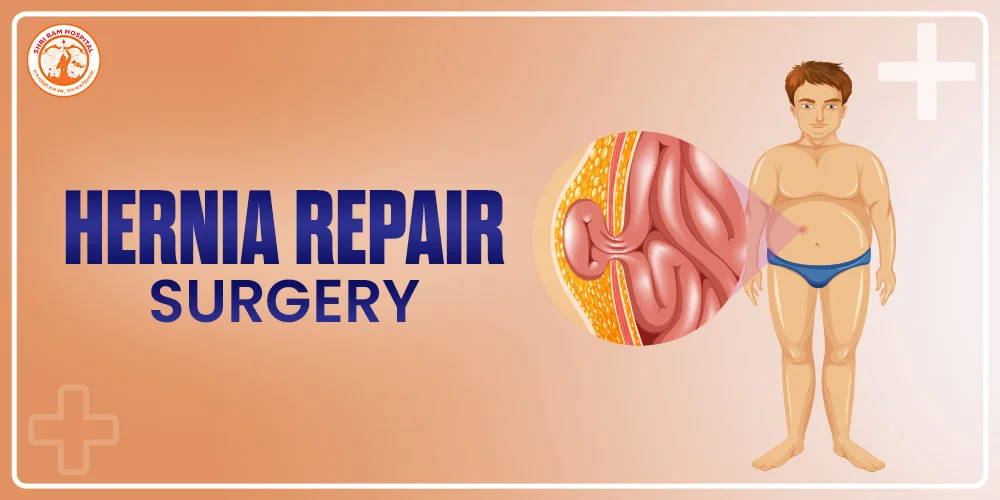
A hernia develops when an internal organ or fatty tissue pushes through a weakened area in the surrounding muscle or connective tissue. Hernias most commonly develop in the abdomen or groin.
Hernias generally do not heal on their own. While some hernias may initially be managed through observation or other measures depending on the patient's circumstances, surgery is the definitive treatment when surgical repair is indicated.
Common Types of Hernia
Inguinal Hernia: The most common type of hernia, occurring in the groin area and particularly common in men.
Umbilical Hernia: Develops near the belly button. It can occur in adults and may be associated with factors such as obesity or pregnancy.
Femoral Hernia: Occurs near the upper thigh or groin and is more common in women.
Incisional Hernia: Develops through or near a previous surgical incision because of weakness in the abdominal wall.
Hiatal Hernia: Occurs when part of the stomach moves through an opening in the diaphragm into the chest.
Epigastric Hernia: Develops in the upper abdomen, above the belly button.
Symptoms of Hernia
The symptoms of a hernia can vary depending on its type, location, and size. Some hernias may initially cause few symptoms, while others can result in visible swelling, discomfort, or pain, particularly during physical activity.
- Visible swelling or bulge in the abdomen or groin
- Pain while lifting heavy objects
- Groin discomfort
- Burning sensation around the swelling
- Pain during coughing or bending
- Feeling of heaviness in the abdomen
- Swelling that increases while standing
- Discomfort after prolonged physical activity
Seek immediate medical attention if a hernia swelling becomes painful, firm, or cannot be pushed back into the abdomen. These symptoms can indicate incarceration or strangulation, which may require urgent surgical assessment and treatment.
Causes and Risk Factors
A hernia can develop when there is a weakness in the abdominal wall combined with increased pressure inside the abdomen. Several factors can contribute to the development or progression of a hernia.
- Weak abdominal muscles
- Heavy weight lifting
- Chronic cough
- Chronic constipation
- Obesity
- Pregnancy
- Previous abdominal surgery
- Aging
- Smoking
- Family history
Maintaining a healthy body weight, avoiding smoking, managing chronic cough and constipation, and following appropriate physical activity practices may help reduce some risk factors. However, once a hernia develops, these measures do not repair the existing defect in the abdominal wall.
Surgical repair is the definitive treatment for a hernia when surgery is indicated. The decision to operate depends on factors including the type and size of the hernia, symptoms, risk of complications, and the patient's overall health.
Diagnosis of Hernia
Accurate diagnosis is an important part of planning hernia treatment. The surgeon evaluates the location and characteristics of the swelling, symptoms, medical history, and whether the hernia is reducible.
Medical History and Physical Examination
A physical examination is often sufficient for diagnosing a visible and reducible hernia. The surgeon may examine the swelling while the patient is standing, coughing, or performing specific movements.
Ultrasound
Ultrasound may be recommended when the diagnosis is uncertain or when additional information about the hernia and its contents is required.
CT Scan
A CT scan may be used for complex, recurrent, or unclear cases and can provide detailed information about the abdominal wall and surrounding structures.
MRI
MRI may be used selectively, particularly when an occult or atypical hernia is suspected and other investigations have not provided a clear diagnosis.
The combination of clinical examination and appropriate imaging helps determine the location, type, size, and characteristics of the hernia and supports selection of the most suitable surgical approach.
Hernia Surgery: Open vs. Laparoscopic
Since hernias do not generally heal on their own, surgery is the definitive treatment when surgical repair is recommended. Hernia surgery can generally be performed using an open approach or a minimally invasive laparoscopic approach.
Laparoscopic Hernia Surgery
Laparoscopic hernia surgery is a minimally invasive procedure performed through small incisions using a camera and specialized surgical instruments. A surgical mesh is typically used to reinforce the weakened area of the abdominal wall and help reduce the risk of recurrence.
Benefits of Laparoscopic Hernia Repair
- Smaller incisions and generally less bleeding
- Less postoperative pain in many patients
- Faster recovery and potentially shorter hospital stay
- Lower risk of wound infection in selected cases
- Earlier return to work for many patients, depending on the procedure and occupation
- Better cosmetic results due to smaller incisions
For many patients, laparoscopic repair can be an appropriate treatment option. However, the most suitable technique depends on the hernia type, size, location, previous surgeries, overall health, and surgeon's clinical evaluation.
Bilateral, recurrent, or certain complex hernias may favor one surgical approach over another. The final decision should be made after a detailed consultation and assessment.
Open Hernia Repair
Open hernia repair remains an appropriate option for selected patients, particularly in certain large, complex, or strangulated hernias, or when laparoscopic access is not suitable.
During an open procedure, the surgeon accesses the hernia through an incision and repairs the weakened abdominal wall. Mesh may be used when appropriate to reinforce the repair and reduce the likelihood of recurrence.
Your surgeon will recommend the most appropriate approach after considering the type of hernia, size and location, symptoms, previous surgical history, overall health, and individual treatment requirements.
Hernia Surgery Cost in Delhi
The hernia surgery cost in Delhi can vary depending on several factors, including the type and complexity of the hernia, surgical technique, mesh used, hospital facilities, and the patient's overall medical condition.
Factors Affecting Hernia Surgery Cost
- Type of hernia — inguinal, umbilical, incisional, femoral, or other types
- Size and complexity of the hernia
- Open versus laparoscopic technique
- Type of surgical mesh used for repair
- Hospital stay and operation theatre charges
- Surgeon's expertise and experience
- Associated medical conditions that may require additional evaluation or care
| Procedure | Approx. Cost Range (₹) |
|---|---|
| Open Hernia Repair | ₹35,000 – ₹70,000 |
| Laparoscopic Hernia Repair (Inguinal) | ₹55,000 – ₹1,10,000 |
| Laparoscopic Hernia Repair (Umbilical) | ₹50,000 – ₹95,000 |
| Complex/Recurrent Hernia Repair | ₹90,000 – ₹1,80,000+ |
Note: These are indicative cost ranges only. The actual cost of hernia surgery depends on the patient's individual diagnosis, surgical technique, mesh requirements, hospital stay, and other applicable charges. A detailed and personalized estimate should be provided after clinical evaluation.
Whether you are searching for inguinal hernia laparoscopic surgery cost, umbilical hernia operation cost, or general hernia treatment cost, the same core factors can influence the final estimate. An accurate quotation requires an in-person or video consultation and assessment of the specific hernia.
Patients are advised to consider surgical expertise, appropriate hospital infrastructure, safety protocols, and the suitability of the recommended procedure alongside cost when planning hernia treatment.
Recovery After Hernia Surgery
Recovery after hernia surgery depends on the surgical technique, type and complexity of the hernia, the patient's overall health, and the nature of their daily activities.
| Recovery Milestone | Typical Timeline |
|---|---|
| Walking | Same day |
| Discharge Home | Within 24–48 hours in many cases |
| Resume Light Activities | A few days |
| Return to Work (Laparoscopic) | 1–2 weeks, as advised by the surgeon |
| Resume Exercise | After surgeon clearance |
These timelines are general estimates and can vary from patient to patient. Patients should follow their surgeon's postoperative instructions regarding wound care, physical activity, lifting restrictions, medication, diet, and follow-up appointments.
Following postoperative instructions closely can help reduce the risk of complications and support a smooth, long-term recovery.
Preventing Hernia Recurrence
While no measure can guarantee that a hernia will not recur, following appropriate lifestyle and postoperative recommendations can support recovery and may help reduce factors associated with recurrence.
- Maintain a healthy body weight
- Avoid heavy lifting during the recovery period
- Eat a high-fiber diet and take measures to prevent constipation
- Quit smoking
- Control chronic cough
- Exercise regularly after medical clearance
Patients should gradually return to physical activity according to their surgeon's advice. Avoiding excessive strain during the healing period is particularly important after abdominal wall surgery.
Long-term follow-up may also be recommended depending on the type of repair, the complexity of the hernia, and the patient's individual risk factors.
Why Choose Shri Ram Hospital for Hernia Surgery in Delhi
Shri Ram Hospital provides comprehensive evaluation and surgical care for patients seeking hernia treatment in Delhi. The department combines surgical expertise, minimally invasive capabilities, modern infrastructure, and postoperative support to help patients through the treatment journey.
| Why Choose Us | What It Means for Patients |
|---|---|
| Experienced Laparoscopic Surgeons | Access to surgeons experienced in minimally invasive hernia procedures. |
| Advanced Minimally Invasive Surgery Capability | Facilities supporting laparoscopic evaluation and treatment when clinically appropriate. |
| Modern Modular Operation Theatres | Operation theatre facilities equipped for surgical procedures, including HD laparoscopic equipment. |
| Personalized Treatment Plans | Treatment planning based on hernia type, severity, medical history, and individual requirements. |
| Comprehensive Preoperative Evaluation | Assessment before surgery to help determine the appropriate treatment and surgical approach. |
| ICU Support | Access to critical-care support when required, particularly for patients with complex medical needs. |
| NABH-Standard Patient Care | Hospital care supported by established quality and patient-safety protocols. |
| Dedicated Postoperative Follow-Up | Follow-up care to monitor recovery and address postoperative concerns. |
Comprehensive Hernia Care in Delhi
From the initial consultation and diagnosis to laparoscopic or open hernia repair and postoperative follow-up, Shri Ram Hospital aims to provide coordinated care according to each patient's condition.
If you notice a persistent abdominal or groin swelling, experience discomfort while lifting or coughing, or have symptoms that may indicate a hernia, consult a qualified surgeon for an appropriate evaluation. Early assessment can help determine the nature of the hernia and whether surgical treatment is required.
Book a Hernia Surgery Consultation
Patients looking for a hernia surgeon in Delhi can schedule a consultation at Shri Ram Hospital for evaluation, diagnosis, and discussion of suitable treatment options.
Book an Appointment